


Foresight
Google AI Edge accelerates Foresight on macOS by sharing 60% of its Flutter and on-device AI stack
Success metrics
60%
shared infrastructure stack with Eloquent
80%
initial engineering time saved through package reuse
22
MediaPipe tasks available to Flutter developers
During fast-moving meetings, staying engaged in the conversation while capturing accurate, actionable notes is a constant balancing act. Google AI Edge Foresight solves this challenge as an offline-first, AI-enhanced meeting and note-taking companion for macOS, powered locally by EmbeddingGemma 2 and Gemma 4. Foresight lets users jot down shorthand notes during a meeting and expands them into complete, structured notes alongside live transcripts, real-time Q&A, and summaries, all running directly on the user's device.
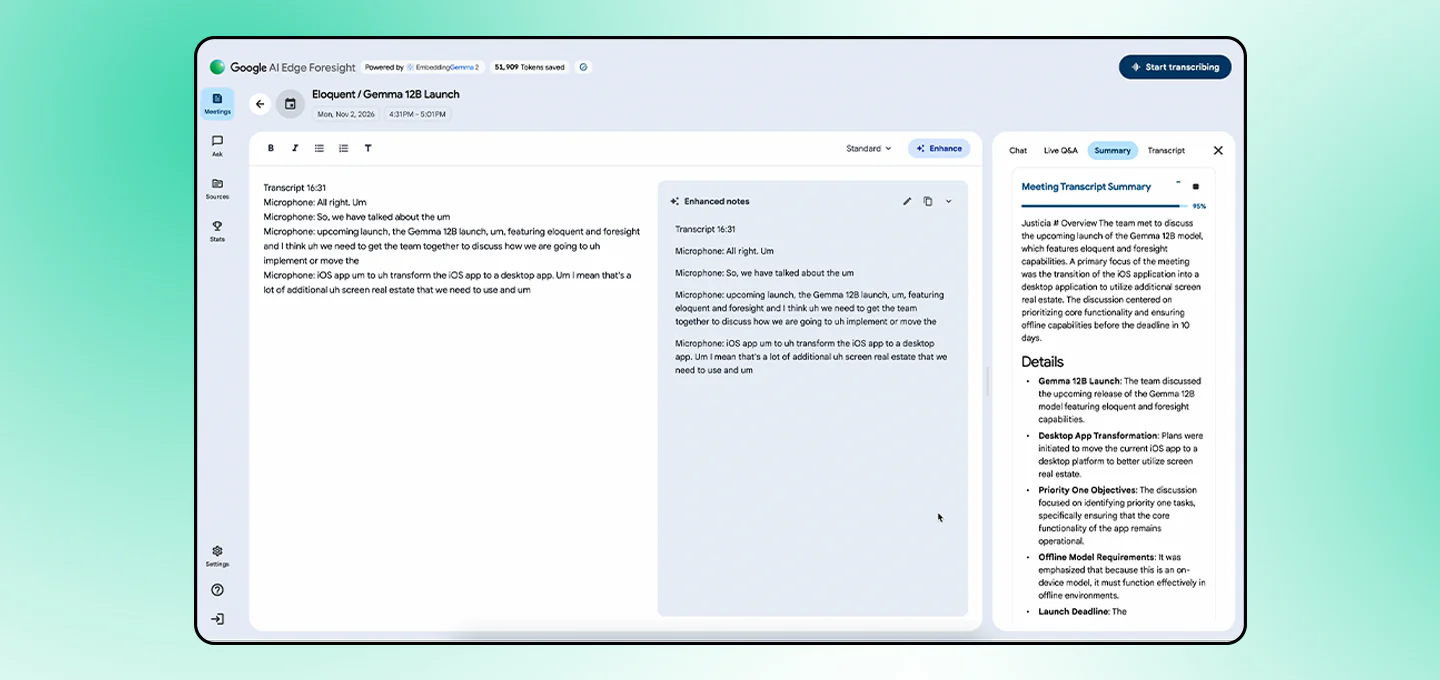
Built by Google AI Edge Labs alongside its sister dictation app Google AI Edge Eloquent, Foresight serves as a flagship reference application demonstrating what developers can build on desktop using Google's core on-device AI SDKs. After Eloquent climbed into the Top 20 on the App Store, earned over 100 press mentions, and expanded from iOS to macOS in 10 days for the Gemma 4 12B launch, the team turned that modular Flutter foundation into the launchpad for Foresight.
Why Flutter? Sharing native C++ AI pipelines and UI across a desktop suite
When the Google AI Edge team began building with Flutter and Dart, none of the engineers had prior Flutter experience. Thanks to Dart's approachable syntax, Flutter's declarative widget model, and thorough documentation, the team became productive right away, using Flutter not only for responsive desktop interfaces but also as a unified orchestration layer for local machine learning models.
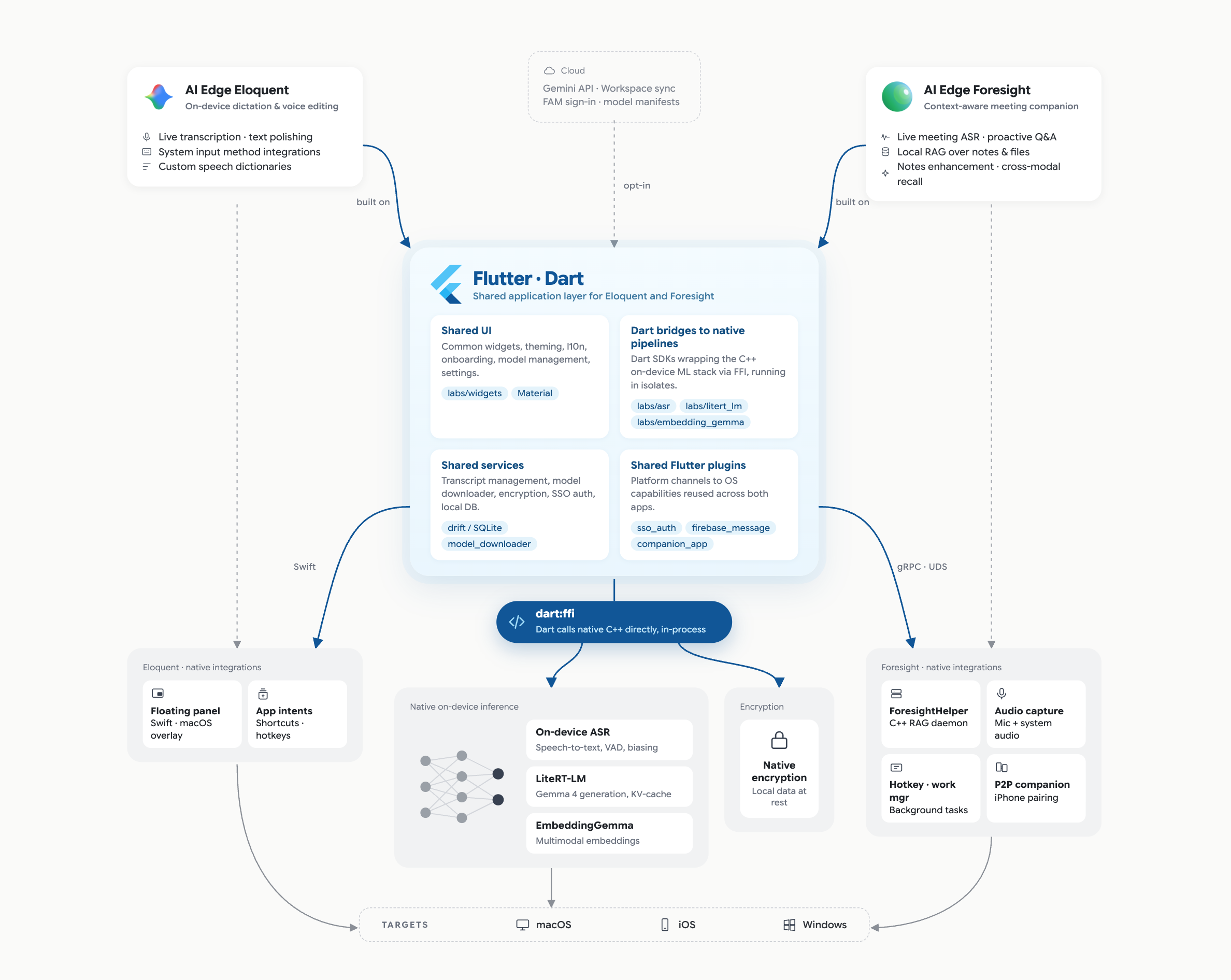
Under the hood, Foresight runs local Gemma and EmbeddingGemma 2 models
through LiteRT-LM,
Google's high-performance on-device inference framework.
Foresight and Eloquent's transcription, embedding, and retrieval pipelines
run on the same code that powers Google's newly released MediaPipe Tasks,
including Audio Transcriber, Universal Embedder, and SemanticRetriever.
By bridging Dart to native C++ via dart:ffi,
the team exposed low-level inference, embeddings, and audio capture
through clean, reusable Dart packages.
Any Flutter developer can build on top of these same underpinnings
with the Flutter MediaPipe
package,
which supports all 22 MediaPipe tasks.
Building with Flutter: Reusing 60% of the stack to focus on meeting UX
Because the team architected Eloquent as modular Dart and Flutter packages from the start, Eloquent and Foresight share roughly 60% of their overall infrastructure stack. Rather than spending months rebuilding low-level systems plumbing from scratch, the Foresight team reused shared middle-tier packages for chunked model downloading, local encryption, isolate management, and C++ LiteRT-LM FFI orchestration from day one.
On the surface, Foresight also reused Eloquent's shared Flutter design library, ensuring both applications look and feel like one cohesive Google AI Edge suite. Interactive UI components built for Eloquent, including the custom diff animation that visually highlights AI-generated edits, carried directly over into Foresight's note-enhancement workflow. Eliminating that duplicate UI and C++ runtime work cut an estimated 80% of initial engineering time, freeing engineers and designers to focus on Foresight's meeting intelligence experience across note-taking, enhanced notes, and contextual retrieval.
"Flutter is not only great for UI, you can use it as a single bridge to native pipelines as well. Don't limit yourself to thinking Flutter is a great UI tool for you to build cross-platform, but also think of ways to optimize your entire stack using Flutter."
- Google AI Edge Engineering Team
Key results and business impact
By building Foresight on a shared Flutter and Dart architecture, Google AI Edge Labs accelerated desktop delivery across its local AI suite:
- 60% shared infrastructure stack: Reused Eloquent's Flutter design library, interactive UI components, and Dart-to-C++ AI middle tier directly across applications.
- Nearly 80% initial engineering time saved: Avoided months of duplicate systems engineering by sharing model downloading, local encryption, isolate orchestration, and LiteRT-LM FFI bindings.
- Cohesive multi-app desktop experience: Delivered consistent visual polish and shared interactive components, including the signature diff animation, across Eloquent and Foresight on macOS.
- Graduated SDKs for the Flutter ecosystem: Packaged the underlying C++ ML capabilities into the open-source Flutter MediaPipe package supporting all 22 MediaPipe tasks, including Audio Transcriber, Universal Embedder, and SemanticRetriever.
Ready to build on-device AI experiences in your own Flutter apps?
Get started with the
flutter_mediapipe package on pub.dev,
explore the source code in the
flutter-mediapipe GitHub repository,
and consult the Google AI Edge and LiteRT-LM documentation.
To experience the Google AI Edge Labs showcase apps firsthand, explore Google AI Edge Foresight, visit Google AI Edge Eloquent, or download Eloquent on the App Store.